HISTORY AND CULTURE

Ancient Church of Sant’Elena

The exact age of the old church of Sant’Elena is still unknown; however, it is thought to date back to around the 12th century, when Lotzorai lay between the sea and the mountains, in one of Sardinia’s wildest settings.

Built in a location slightly above the town, called Cuccureddu, it served as a parish church until construction of the new church of Sant’Elena began in 1822 and was completed in the late 1840s.

Located within the old cemetery, bordered by a surrounding wall, if you imagine crossing its entrance gate, you find yourself faced with a dirt road that separates the old cemetery into two parts. Walking along it, you can admire the remains of several tombs, surrounded in the spring by a flowery meadow. After crossing it in its entirety, overcoming a difference in altitude of about a meter and a half, you find yourself before the remains of the religious complex.
The Church

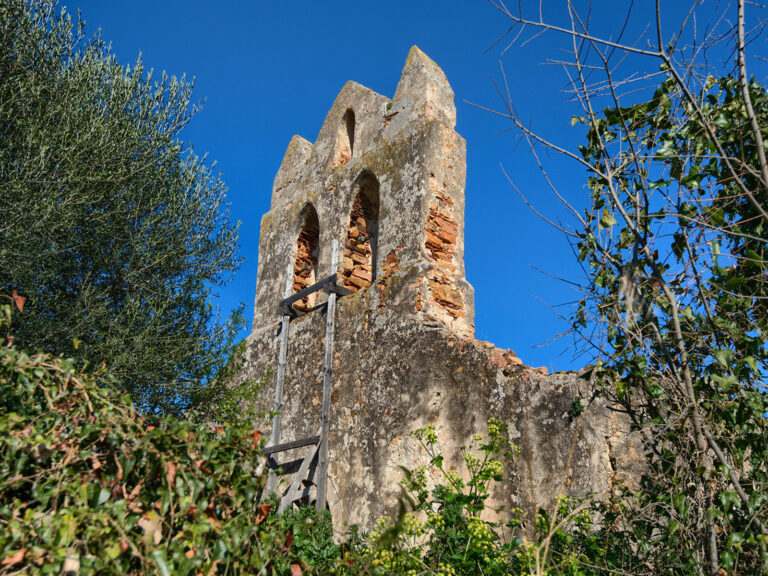
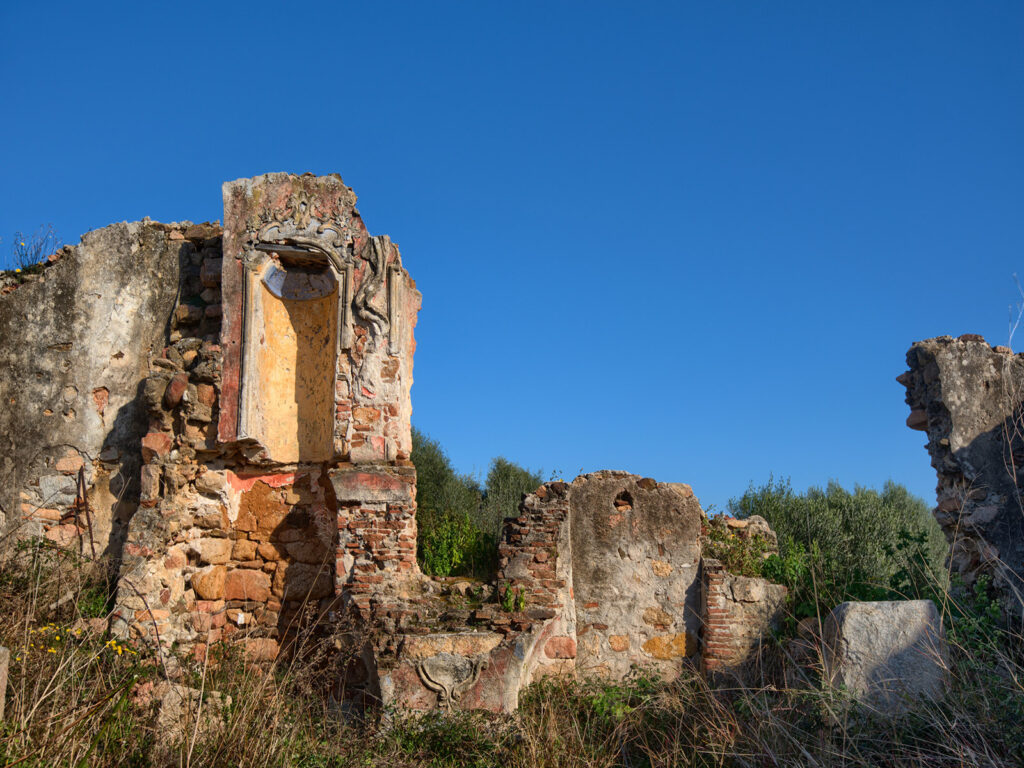
Of the rectangular building, now devoid of its “gable” roof, consisting of wooden beams and a tiled roof (disassembled around 1950), four perimeter walls remain, approximately two meters high, marking the boundaries of this open-air masonry box. The church, located at the end of the narrow street, is oriented with the main entrance on the short west side. Opposite the east facade is a pile of rubble, likely the sacristy. On the left are the ruins of the ossuary. The top of the church’s main façade is characterized by a majestic bell gable. This, in its architectural peculiarity, consists of three pointed arches, two below and a small one above, flanked by two pyramid-shaped elements. The façade is completed by a round-arched entrance portal, adorned with two molded brackets at the impost, all constructed from well-squared blocks of sedimentary stone, the same stone used for the façade’s cornerstones. From the interior, the main façade is composed of a double wall. The innermost wall extends along the central section, abutting and surmounting the façade, forming the bell tower with a pointed arch opening. The old paving, characterized by terracotta bricks of various sizes, is still present in some areas. Furthermore, remains of stone pillars and columns that supported the brick arches and formed the two arched walls divided the liturgical space into three naves. On the longer sides are four windows, two on each side. On the south-facing façade, in addition to the two single-lancet windows, there is a third opening, the door, designed and built as the secondary side entrance to the church. Finally, on the back wall, a niche framed by bas-reliefs still shows traces of paint, and the remains of a brick altar adorned with Baroque stucco (dating back to the late 18th century AD) inspire us to imagine the beauty and atmosphere of that previously unknown space. Currently, the church features several construction techniques from various periods, suggesting several phases of transformation of the structure. We can hypothesize an initial construction phase between the second half of the 11th century and the first quarter of the 12th century AD.

The Church

Of the rectangular building, now devoid of its “gable” roof, consisting of wooden beams and a tiled roof (disassembled around 1950), four perimeter walls remain, approximately two meters high, marking the boundaries of this open-air masonry box. The church, located at the end of the narrow street, is oriented with the main entrance on the short west side. Opposite the east facade is a pile of rubble, likely the sacristy. On the left are the ruins of the ossuary. The top of the church’s main façade is characterized by a majestic bell gable. This, in its architectural peculiarity, consists of three pointed arches, two below and a small one above, flanked by two pyramid-shaped elements. The façade is completed by a round-arched entrance portal, adorned with two molded brackets at the impost, all constructed from well-squared blocks of sedimentary stone, the same stone used for the façade’s cornerstones. From the interior, the main façade is composed of a double wall. The innermost wall extends along the central section, abutting and surmounting the façade, forming the bell tower with a pointed arch opening. The old paving, characterized by terracotta bricks of various sizes, is still present in some areas. Furthermore, remains of stone pillars and columns that supported the brick arches and formed the two arched walls divided the liturgical space into three naves. On the longer sides are four windows, two on each side. On the south-facing façade, in addition to the two single-lancet windows, there is a third opening, the door, designed and built as the secondary side entrance to the church. Finally, on the back wall, a niche framed by bas-reliefs still shows traces of paint, and the remains of a brick altar adorned with Baroque stucco (dating back to the late 18th century AD) inspire us to imagine the beauty and atmosphere of that previously unknown space. Currently, the church features several construction techniques from various periods, suggesting several phases of transformation of the structure. We can hypothesize an initial construction phase between the second half of the 11th century and the first quarter of the 12th century AD.

IMAGE GALLERY

Ancient Church of Sant’Elena